
Employer online reviews: should you respond?

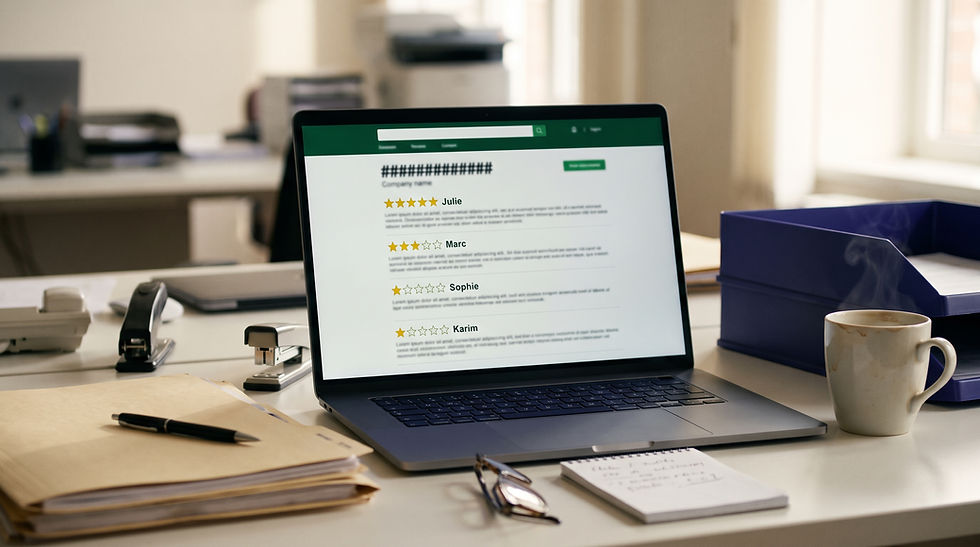
Employer reviews online are no longer read after the fact. In Belgium as anywhere else, a candidate invited to an interview opens Google, sometimes Indeed or Glassdoor, and looks at what former employees wrote.
That happens before the questions are prepared, not after.
Most business leaders come across them by accident, and rarely the best one. Two reflexes follow: reply within the minute, or do nothing. Both are paid for later.
📋Key points
A review is read before the interview. It belongs to your first impression, like the job advert.
Replying is the rule. Replying the same day is not.
A public reply never confirms that someone worked for you, nor how they left.
Asking someone still on your payroll for a review is not neutral: the line of authority weighs on the answer.
Three reviews pointing at the same thing stop being an opinion. They are a signal about a process.
Where employer reviews online actually sit
Four places hold most of it: your Google listing, where customer and former employee reviews sit side by side with nothing to tell them apart, the employer pages on Indeed and Glassdoor, fed almost entirely by employees and candidates, and the comments under your LinkedIn posts, which stay visible for a long time.
Those pages have one thing in common: you do not own them. You choose neither what is written nor the order it appears in. Which is why a recruitment campaign does not repair a damaged reputation: the campaign stops, the page stays.
What you cannot ask an employee

The temptation is familiar: lift the average by asking the team to leave a favourable review. Two problems follow: personal data, and commercial practice.
A review published under someone's name is personal data. The GDPR requires consent to be freely given, and withdrawable at any time. Between a business leader and someone still employed, the line of authority makes that freedom doubtful: many will agree simply to avoid displeasing. Consent obtained that way protects nobody.
On commercial practice, the Belgian federal economy department has published guidelines on online reviews (new tab, page in French and Dutch). They address consumer reviews first, but the principle carries over: keep every review, positive and negative, state clearly when only a selection is displayed, flag anything paid for. Filtering without saying so can amount to an unfair commercial practice.
Three requests to rule out:
Writing the text for the employee, or feeding them the wording.
Offering a benefit or a favour in return for a review.
Placing the request at the moment of departure, during offboarding.
One sound practice is left: make the gesture possible without asking. Those who write will write because they wanted to, and it shows.
Reply, but never on the day
The position fits in one sentence: always reply, never the same day. Sleep on it. Text written while it stings defends the company against a person. Text written the next morning speaks to whoever reads the page in six months. Only the second counts.
One person replies, always the same one. A tone that shifts from one review to the next is noticed immediately.
A reply that holds | A reply that makes it worse |
Thanks the person for the time taken | Disputes the facts point by point |
Acknowledges the subject raised | Confirms that the person worked for you |
Says what has changed since | Promises a fix that has not been decided |
Offers to continue in a direct channel | Is ironic, dismissive or doubts the sincerity |
Runs to a few lines | Unfolds a full argument |
The second line is the one most often missed. Confirming in public that someone was part of the company, or referring to the terms of their departure, discloses information you are not free to disclose. You answer the subject, never the file.
A bad review is an internal signal first.

A single review describes one person's experience. Three reviews pointing at the same subject, how new joiners are received, a manager who never answers, hours announced and then changed, describe a process, not a personality.
I see the same sequence regularly. The subject was known internally long before it appeared online. It circulated by the coffee machine and reached nobody. The review created nothing, it made public what was already known.
So the first useful reaction is not the public reply, it is an internal check. Listen to the field before you recruit applies after a departure too: the people still in place know whether the review is isolated or representative.
When the same subject keeps returning, the work is not communication work. It sits on the process concerned: onboarding, performance conversations, offboarding.
Frequently asked questions
Can a negative review be removed?
Rarely. Platforms take down what breaks their own rules: insults, discriminatory content, details identifying a person, content that is plainly false. An unpleasant but sincere review falls into none of those.
Should positive reviews get a reply too?
Yes, and shorter. A page where only negative reviews get an answer reads as a company on the defensive. Two lines are enough.
Is a former employee allowed to write that?
Expressing an opinion is allowed. The limit sits elsewhere: confidential information, insulting language, false allegations presented as fact. Have the text assessed by a lawyer before taking any step.
 | Let's talk about your situationA first conversation, with no commitment. You leave with a clear view of your priorities. |



Comments